Internship Post for week of 15-18 April
FEVI/ Muñequitos de Lumbisí
Another day at FEVI, on Wednesday I was sent on a mission to buy a sheet of paper with fish pictures to cut out and pass out to the children so they can learn the concept of the water cycle and the fish in the sea.
Although its been almost 5 months since I have come to Ecuador, I still have some issues with miscommunications. This time Profe Jaime told me to¨va arriba para comprar papeles lamines,¨ meaning ¨go up to buy laminated(?) paper," and handed me 15 cents. So I literally went upstairs to the FEVI classroom and asked the profe there if I can buy laminated paper there, which I thought was kind of weird paying another teacher for materials, but since that's what Profe Jaime told me to do, that's what I asked for. She looked at me as if I was asking her something really strange and asked me to repeat the question. I asked her again and she gave me that same face. Not knowing what to do, I just told her that I would go ask Profe Jaime again. So I went downstairs and what I see is Profe Jaime waiting for me at the gate with the keys. --Then I realized that he wanted me to go out of the FEVI foundation building and go up the hill to buy laminated paper at the store (it made sense when I thought over it a bit). I felt a bit embarassed -not that I should- and just pretended like nothing happened and just asked him for the directions and went up to go find the store.
But of course, as Daniel mentioned before, people in Ecuador don't really know how to give directions. I followed towards the direction where Profe told me to go and found nothing. So I went around tienditas to ask the señoras whether they knew where Papeleria Cuñes was. And, as expected, every single one of them did not fail to tell me completely different things. Eventually I found it and bought the fish pictures paper and went back to FEVI.
We did an activity where we cut out around a fish-bowl (drawn on a paper), glued a clear-blue paper behind the cut-out-fish-bowl and pasted on a fish in this water in the fish-bowl. While they did this activity, Profe Jenny taught them a knew song about two fish in the sea, one small, swimming down to the bottom and finding a shark waiting to eat him. The song itself was very simple and easy to memorize, but I still find myself amazed seeing the kids being able to memorize the lyrics and hand-gestures and melody so quickly. And at the same time, I find it still difficult to memorize the lyrics even though the song only consists of simple words that I definitely know.
Then I realized that I also learned alot of songs in elementary school about different things, and to this day I still remember many of them. I still remember the melodies and lyrics to the name-the-US-states-song as well as the US-preamble song (not something I would memorize if it weren't for the song for sure).
Something about music (the sound, melody and words that go along with it) really sticks to your mind. Even if its not a song, it helps to study for tests (like vocab) if you actually pronounce it out and keep repeating it. So there's clearly a connection with your brain and speaking things out loud with memorization.
Which leads me to think of the difficulties of learning things and memorizing them when you're deaf. I'm sure there are different ways to learn things and put them into the long-term memory as it is mentioned in Howard Gardner's Multiple Intelligences. But I also wonder what the affects of being deaf are in your learning. What other ways are there to really learn something thoroughly? How do you teach something you're so used to having in life?
CENVIDA
I got to CENVIDA on Thursday without Rosita there again. Coming here always makes me realize the difference between this school and FEVI. The amount of resources is clearly different but what really surprises me is how disorganized and laid-back (unprofessional?) the staff are. There are as many (or as little) profesores as FEVI, and sooo much less kids. It is clearly harder to deal with children that cannot hear, but I sometimes wonder how the profes at FEVI would deal with the kids at CEVIDA, and vice versa.
As before, I imagined Rosita will arrive late and she would just take over later on. However, it ended up that she did not show up at all the whole time I was there. Thank goodness they have karate on Tuesdays and Thursdays since I don't think I could've held their attention for four hours. Speaking of attention, it may help to try out the activity-play-activity-play strategy that Profe Jaime uses but I also wonder whether that is good for the kids at CENVIDA at the same time. The issue here is that there is such a huge age difference within the classroom. It could also definitely be a positive aspect but when it comes to teaching, I feel like it sometimes takes away from the amount of things that each individual could be learning when they are placed in a setting so many different levels of knowledge and capacities.
At around 9:30am, I started losing their attention (only after about an hour and a half) to the point where they just would not listen to me what ever I said. This is when I raised my voice to the first time to Yamileth. She seemed to understand that I was unhappy and sat down but after a few minutes started to get out of control once again. I guess that's how kids are, but I really find it amazing that the profe for the middle-age group always has her students under control. She definitely intimidates me but it's also a skill that she is able to handle her students well. Rather, Rosita astounds me from the way she is able to stay calm and happy but also handle the students very well at the same time (especially Yamileth).
The complimenting technique definitely works (mostly) for the FEVI ositos kids, but definitely not as well with the CENVIDA. I wonder whether it has to do with them being able to hear the pitch of my voice.
Monday, April 29, 2013

Tuesday, April 16, 2013
Weekly Internship Post 5
Post: week of (8-14 April)
Fevi/ Muñequitos de Lumbísí
 This week was quite interesting. Since the other girl volunteers haven´t been showing up recently I´ve been able to stay with the Ositos. So Monday was quite enjoyable being able to once again run around with the little kids that are a tiny bit more manageable than the Leonsitos.
For some reason Leiver was balling for his mommy which is super-rare since I imagined him to be one of those little boys too cool to even miss mom. But obviously they are still little children (hes 4-5) and apparently that one day he terribly missed his mom and was literally crying for hours and hours. But next time I came he was the happy Leiver that I had always known. Except this time he was super hyper and running into me and telling me to take his arms and spin around and randomly calling me Chinita (the one thing I hate about this place).
Anyways, wednesday was a bit special because I spent the whole morning not in class helping the children but helping Profe Jaime make a new tree house looking thing next to the new soccer field. I am not sure if he gets all those wood and materials from some store and buys them or just gets them for free from some dumpster but everytime I am amazed with the amount of resources this place has to work with.
At the same time, I am also always amazed at how much Jaime cares about the kids. Now this is a pretty old guy but he runs around chasing kids more than I do and goes on making a new tree house with his old man body.
I really need to find the opportunity to talk to him more.
CENVIDA
 Another interesting week.
This whole week I was with the little kids but Monday I went to go help out a little bit with the math (multiplications) for the big kids.
This is one thing I really admire as well as struggle with when it comes with math.
I remember learning my multiplications with a song in Japanese that went through all numbers.
When the kids can´t hear nor speak, what is the best way for them to learn and memorize things like multiplications?
Paul, the oldest kid at Cenvida (17 years old) struggles with the simplest multiplications. I think he just simply does not understand what multiplying is or perhaps just a lack of reviewing materials.
There are definitely kids that do get the simple multiplications, so I'm assuming they either practice more or just a little bit more math-minded.
This same day, a boy from the middle-age class (about 10 years old) came up to me trying to communicate something. He kept saying something but I had no idea what he wanted to say so I kept shrugging and trying to understand using gestures. But there was no way I could understand what he was saying and finally he got super mad and slapped the table and walked away. That moment was (i admit) quite depressing for me.
Also, a girl from the older kids class was feeling sick and asking me something. Again, I did not understand what she was saying and struggled communicating and I would ask her what I thought she was asking me so I could double check that that is what she wanted. But she kept saying no and I felt so bad not being able to understand. Finally another girl helped me do what the girl wanted (get toilet paper)...which was actually what I understood and was asking the girl to make sure that was what she was saying but she did not understand what I was saying either. So it made it worse having her say something and actually understanding but not realizing that either.
Additionally, the highlight of this week of CENVIDA for me was being able to ask Rosita (the teacher for the little kids class) some questions about CENVIDA and about the kids. Since it's quite a bunch, I'll be listing them:
-at CENVIDA, the kids pay $60 per month for teachers pay and basic service like water
-only kids tha can pay pay. The majority of the students cannot pay all the $60 and some of them do not pay at all because they simply cannot afford it (like yamileth and christian)
-the kids bring their own books and notebooks
-the government doesn't pay for the education for the deaf kids (some places yes, pay a little but not a CENVIDA)
-the hearing aids are generally free - paid for by the government but people can pay more for better quality ones as well (like jorge and alejo)
-the karate teacher is paid $7 per month by each student, but only those that can pay (same ones cannot pay)
-there is a saturday school for the parents, for them to learn sign-language so they can communicate better with their kids - kids generally learn little by little at school
-some info about the kids: Yamileth's family is poor, she has 3 siblings, oldest one got married and had kids at 14 years, the youngest 2 years old and cannot hear either, very small and struggles walking. Jorge and Alejo's family are generally able to afford the fees. As Y, Christian does not pay either. Samirs mom has cancer so he pays a portion.
-theres a school for solo kids (what ever that means?) where most of them get married and have kids from around 12 years old
-there's a deaf-mute children's school in Rio Coca right by my house also but there the kids pay a portion to teachers and another to the government so they get some other service in return.
Some interesting info, I hope I can use some of this for the final creative journal project :)
Fevi/ Muñequitos de Lumbísí
 This week was quite interesting. Since the other girl volunteers haven´t been showing up recently I´ve been able to stay with the Ositos. So Monday was quite enjoyable being able to once again run around with the little kids that are a tiny bit more manageable than the Leonsitos.
 For some reason Leiver was balling for his mommy which is super-rare since I imagined him to be one of those little boys too cool to even miss mom. But obviously they are still little children (hes 4-5) and apparently that one day he terribly missed his mom and was literally crying for hours and hours. But next time I came he was the happy Leiver that I had always known. Except this time he was super hyper and running into me and telling me to take his arms and spin around and randomly calling me Chinita (the one thing I hate about this place).
Anyways, wednesday was a bit special because I spent the whole morning not in class helping the children but helping Profe Jaime make a new tree house looking thing next to the new soccer field. I am not sure if he gets all those wood and materials from some store and buys them or just gets them for free from some dumpster but everytime I am amazed with the amount of resources this place has to work with.
At the same time, I am also always amazed at how much Jaime cares about the kids. Now this is a pretty old guy but he runs around chasing kids more than I do and goes on making a new tree house with his old man body.
I really need to find the opportunity to talk to him more.
CENVIDA
 Another interesting week.
This whole week I was with the little kids but Monday I went to go help out a little bit with the math (multiplications) for the big kids.
This is one thing I really admire as well as struggle with when it comes with math.
I remember learning my multiplications with a song in Japanese that went through all numbers.
When the kids can´t hear nor speak, what is the best way for them to learn and memorize things like multiplications?
Paul, the oldest kid at Cenvida (17 years old) struggles with the simplest multiplications. I think he just simply does not understand what multiplying is or perhaps just a lack of reviewing materials.
There are definitely kids that do get the simple multiplications, so I'm assuming they either practice more or just a little bit more math-minded.
This same day, a boy from the middle-age class (about 10 years old) came up to me trying to communicate something. He kept saying something but I had no idea what he wanted to say so I kept shrugging and trying to understand using gestures. But there was no way I could understand what he was saying and finally he got super mad and slapped the table and walked away. That moment was (i admit) quite depressing for me.
Also, a girl from the older kids class was feeling sick and asking me something. Again, I did not understand what she was saying and struggled communicating and I would ask her what I thought she was asking me so I could double check that that is what she wanted. But she kept saying no and I felt so bad not being able to understand. Finally another girl helped me do what the girl wanted (get toilet paper)...which was actually what I understood and was asking the girl to make sure that was what she was saying but she did not understand what I was saying either. So it made it worse having her say something and actually understanding but not realizing that either.
Additionally, the highlight of this week of CENVIDA for me was being able to ask Rosita (the teacher for the little kids class) some questions about CENVIDA and about the kids. Since it's quite a bunch, I'll be listing them:
-at CENVIDA, the kids pay $60 per month for teachers pay and basic service like water
-only kids tha can pay pay. The majority of the students cannot pay all the $60 and some of them do not pay at all because they simply cannot afford it (like yamileth and christian)
-the kids bring their own books and notebooks
-the government doesn't pay for the education for the deaf kids (some places yes, pay a little but not a CENVIDA)
-the hearing aids are generally free - paid for by the government but people can pay more for better quality ones as well (like jorge and alejo)
-the karate teacher is paid $7 per month by each student, but only those that can pay (same ones cannot pay)
-there is a saturday school for the parents, for them to learn sign-language so they can communicate better with their kids - kids generally learn little by little at school
-some info about the kids: Yamileth's family is poor, she has 3 siblings, oldest one got married and had kids at 14 years, the youngest 2 years old and cannot hear either, very small and struggles walking. Jorge and Alejo's family are generally able to afford the fees. As Y, Christian does not pay either. Samirs mom has cancer so he pays a portion.
-theres a school for solo kids (what ever that means?) where most of them get married and have kids from around 12 years old
-there's a deaf-mute children's school in Rio Coca right by my house also but there the kids pay a portion to teachers and another to the government so they get some other service in return.
Some interesting info, I hope I can use some of this for the final creative journal project :)
Thursday, April 4, 2013
Spring Break!
So, for spring break I started off going to Cuenca with Libbie, Bryan, Sam, and Fernando.
First time really hanging out with them (actually, first time meeting Sam and Fernando).
I enjoy the fact that I have not really been in a click here but rather been hanging out with almost everyone quite equally and getting to know the whole BCA group very well.
3/21-3/23 (Thurs-Sat)
So from Thursday-Saturday, we stayed at Cuenca at a hostel called AlterNATIVE hostel.
 Cuenca was a beautiful city, filled with old men and women reading newspapers or just hanging out in the park--apparently it is one of the hot spots for retirement places for gringos.
The city itself had so many buildings that were alot more classical-looking than Quito and the people seemed alot more calm as well. And surprisingly, it was nice not getting as many cat-calls as we would have in Quito.
We had some really good freshly-brewed coffee as well as super-rico beer. Climbed up to the top of the church and over-looked the whole city as well as took a night-bus-tour of Cuenca and saw the most beautiful view of the city at night.
It was quite a short trip for a 10 hour bus ride but it was definitely worth it and it was an amazing place to get some relax-time.
Coming back from Cuenca, the other 4 were with me half way there but they got off a little early to get to Baños. I stayed on the bus to get to Quito. A little boy about 7 years old ran on to the bus and started selling Nikolo chocolates.
It was difficult looking at this boy selling chocolate buy himself, with his tiny back pack, tiny hands, tiny self, riding with us for about an hour.
I couldn't get myself to buy the chocolate though. I wasn't sure what impact I could make as a foreigner just staying in Ecuador for a semester. What is the point of foreigners like me spending money when they are going to leave soon anyways. The important thing is for the Ecuadorians to spend money, and for foreigners to spend money on Ecuadorian goods in general rather than personal goods. Also, what can I do by buying a $0.25 chocolate? What is this kid going to spend it on? What is he going to do with the money that he gets from me for begging? $0.25 won't buy education nor will it get him out of his economical situation. Me buying from each and every single child-vendor that I encounter is not going to change their life. So, what do I do?
Taking the ecovia from the Quitumbe station, another two kids ran in by themselves and started singing a song, which spoke of god and their families. This may be quite a US typical image, but it kind of reminded me of Slumdog Millionaire where the kids worked under a rich man, only to raise money for him. What was the life story of these kids? What will paying them do to their lives? Am I even capable of paying with all my school loans? Who am I to think that I can change anything with the $1 I give them? And once again, what will they spend it on? Their dinner for tonight? Or drugs?
3/25-3/28 (Mon-Thurs)
I went to an ecological reserve in between Tena and Talag, about a 5.5 hour ride from Quito.
In the middle of the amazon, this ecological reserve is owned by an English man that has been living in South America for about 30 years with his family that practices Hare Krishna. The place is filled with volunteers all over the world and when me and Jennifer arrived there the first day all we basically did was ate Cacao seeds in order to ferment the seeds for making chocolate.
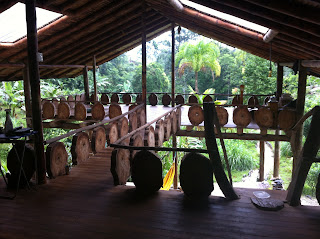 We were not there long enough to fill the bin with fermenting cacao seeds, but we met some people from the US, from Colombia, from Peru, from Chile, from Germany, Canada, Norway, England, and more.
Three meals a day the volunteers made their own food and served the whole group of volunteers, with all personal vegetarian recipes. We did yoga in the morning, which was nice doing in the open air in the middle of the amazon.
We joined a Krishna celebration at the restaurant that the Saraswati owner also had in Tena. It was interesting as well as a good experience joining in a faith-based celebration for something I had never seen nor participated in before. The food was absolutely amazing, and it was great being able to hear Hindi/Bollywood songs again, after so long. I miss dancing Bollywood with my friends back at my university.
The last day there we basically worked in the forest organizing and cutting weeds around sugar cane plants. I don't think I have been bitten so much in my life by soooo many mosquitos and sand flies in my life.
 I really want to go back to see the people (hopefully some of them will still be there by the time I go back) and buy that bracelet that I loved that the guy from Colombia made.
3/29-3/30 (Fri-Sat)
So my sister arrived Thursday night and Friday morning her, myself and Lily left for Baños.
We left the ecovia station and got to Quitumbe, took the 9:40am bus and did not arrive there until around 3:30pm due to the traffic because of Semana Santa week.
My friend Andres, a kayak guide there had helped us reserve a place for that day but also helped us change the date to Saturday because we weren't able to get there on time.
The people here are really super nice and willing to help out its crazy.

Once we got there we basically just walked around, bought some souveniers and I went out with Andres and his friends while my sister and Lily stayed because they were really tired.
Saturday morning we went rafting and had the most amazing time. It had been raining so the water was much higher. That was my second time rafting at Baños but I love it so much I could even go back for a third and fourth time.
We got back and were planning to go puenting but were unable to, so my sister went to go try some cuy which had been on her list of thing to do while here. She seemed to like it which was good since I really didn't like it because of the image stuck in my head and my friends forcing me to eat it back when I went to Cuenca.
We didn't do much in Baños but we had a nice time enjoying the small town and the small stores that they had. I'm also glad to have made friends with a local the last time I went because he had really helped me out in planning that trip.
3/31-4/1 (Sun-Mon)
Sunday morning, me my sister and Lily left for Mindo. A super cheap & short trip $2 for about 2 hours, to another small town kind of like Baños. I honestly liked Baños better but it was great going to the butterfly museum and going to the chocolate tour at the Quetzal chocolate factory right next to our cute little hostal.
 We didn't do much here either, because my sister and I were unable to withdraw money out of the ATM for some reason.
But we had met a girl from LA, which was great considering I hadn't met anyone from the same area as me.
The thing I really love about traveling is meeting people from all over the world. Not just the fact that they are from all over, but listening to their stories have really made me enjoy going places and talking to people.
 4/2 (Tues)
So today's my last day of spring break so I took my sister for a bus tour around Quito.
The Quinde bus started in front of Quicentro next to Parque La Carolina, drove past the Botanical Gardens, Basilica, Centro del Arte Contemporaneo, Plaza Grande/Centro Historico, Panecillo, and finally to Teleferico.
It was quite expensive but it was nice having a bus tour with explanations. I was hoping that we would be able to see some llamas at Teleferico but it was really foggy and we got some nice hikes but weren't able to see anything.
Later at night I took her to La Ronda but I was surprised to see that there were not many people there because the first time we went for the BCA trip the place was filled with people.
Thinking back on that actually just made me sad because the first time we went there was when we were still at Hostal la Carolina, even before we spread to our host families.
I can't believe it has already been 4 months since then.
I honestly love this group so much, it is going to be a serious struggle parting with everyone.
A study abroad experience is not made perfect only because of all the different places you visit, but because of the people you share those experiences with.
Going back to the places we went to as a BCA group (including every single person) will not be/and has not been the same going back alone or with a smaller group.
There's about a month and a half left of this semester with the greatest people. I'm super glad I chose BCA-Quito, and I hope I can take advantage of the time left in the semester to really connect with every single person and enjoy each moment I have here.
Honestly, I don't wanna go back because I love everyone. I would stay here for ever but it would also not be the same without anyone.
First time really hanging out with them (actually, first time meeting Sam and Fernando).
I enjoy the fact that I have not really been in a click here but rather been hanging out with almost everyone quite equally and getting to know the whole BCA group very well.
3/21-3/23 (Thurs-Sat)
So from Thursday-Saturday, we stayed at Cuenca at a hostel called AlterNATIVE hostel.
 Cuenca was a beautiful city, filled with old men and women reading newspapers or just hanging out in the park--apparently it is one of the hot spots for retirement places for gringos.
 The city itself had so many buildings that were alot more classical-looking than Quito and the people seemed alot more calm as well. And surprisingly, it was nice not getting as many cat-calls as we would have in Quito.
We had some really good freshly-brewed coffee as well as super-rico beer. Climbed up to the top of the church and over-looked the whole city as well as took a night-bus-tour of Cuenca and saw the most beautiful view of the city at night.
It was quite a short trip for a 10 hour bus ride but it was definitely worth it and it was an amazing place to get some relax-time.
Coming back from Cuenca, the other 4 were with me half way there but they got off a little early to get to Baños. I stayed on the bus to get to Quito. A little boy about 7 years old ran on to the bus and started selling Nikolo chocolates.
It was difficult looking at this boy selling chocolate buy himself, with his tiny back pack, tiny hands, tiny self, riding with us for about an hour.
I couldn't get myself to buy the chocolate though. I wasn't sure what impact I could make as a foreigner just staying in Ecuador for a semester. What is the point of foreigners like me spending money when they are going to leave soon anyways. The important thing is for the Ecuadorians to spend money, and for foreigners to spend money on Ecuadorian goods in general rather than personal goods. Also, what can I do by buying a $0.25 chocolate? What is this kid going to spend it on? What is he going to do with the money that he gets from me for begging? $0.25 won't buy education nor will it get him out of his economical situation. Me buying from each and every single child-vendor that I encounter is not going to change their life. So, what do I do?
Taking the ecovia from the Quitumbe station, another two kids ran in by themselves and started singing a song, which spoke of god and their families. This may be quite a US typical image, but it kind of reminded me of Slumdog Millionaire where the kids worked under a rich man, only to raise money for him. What was the life story of these kids? What will paying them do to their lives? Am I even capable of paying with all my school loans? Who am I to think that I can change anything with the $1 I give them? And once again, what will they spend it on? Their dinner for tonight? Or drugs?
3/25-3/28 (Mon-Thurs)
I went to an ecological reserve in between Tena and Talag, about a 5.5 hour ride from Quito.
In the middle of the amazon, this ecological reserve is owned by an English man that has been living in South America for about 30 years with his family that practices Hare Krishna. The place is filled with volunteers all over the world and when me and Jennifer arrived there the first day all we basically did was ate Cacao seeds in order to ferment the seeds for making chocolate.
 We were not there long enough to fill the bin with fermenting cacao seeds, but we met some people from the US, from Colombia, from Peru, from Chile, from Germany, Canada, Norway, England, and more.
 Three meals a day the volunteers made their own food and served the whole group of volunteers, with all personal vegetarian recipes. We did yoga in the morning, which was nice doing in the open air in the middle of the amazon.
We joined a Krishna celebration at the restaurant that the Saraswati owner also had in Tena. It was interesting as well as a good experience joining in a faith-based celebration for something I had never seen nor participated in before. The food was absolutely amazing, and it was great being able to hear Hindi/Bollywood songs again, after so long. I miss dancing Bollywood with my friends back at my university.
The last day there we basically worked in the forest organizing and cutting weeds around sugar cane plants. I don't think I have been bitten so much in my life by soooo many mosquitos and sand flies in my life.
 I really want to go back to see the people (hopefully some of them will still be there by the time I go back) and buy that bracelet that I loved that the guy from Colombia made.
 3/29-3/30 (Fri-Sat)
So my sister arrived Thursday night and Friday morning her, myself and Lily left for Baños.
We left the ecovia station and got to Quitumbe, took the 9:40am bus and did not arrive there until around 3:30pm due to the traffic because of Semana Santa week.
My friend Andres, a kayak guide there had helped us reserve a place for that day but also helped us change the date to Saturday because we weren't able to get there on time.
The people here are really super nice and willing to help out its crazy.

Once we got there we basically just walked around, bought some souveniers and I went out with Andres and his friends while my sister and Lily stayed because they were really tired.
Saturday morning we went rafting and had the most amazing time. It had been raining so the water was much higher. That was my second time rafting at Baños but I love it so much I could even go back for a third and fourth time.
We got back and were planning to go puenting but were unable to, so my sister went to go try some cuy which had been on her list of thing to do while here. She seemed to like it which was good since I really didn't like it because of the image stuck in my head and my friends forcing me to eat it back when I went to Cuenca.
We didn't do much in Baños but we had a nice time enjoying the small town and the small stores that they had. I'm also glad to have made friends with a local the last time I went because he had really helped me out in planning that trip.
3/31-4/1 (Sun-Mon)
Sunday morning, me my sister and Lily left for Mindo. A super cheap & short trip $2 for about 2 hours, to another small town kind of like Baños. I honestly liked Baños better but it was great going to the butterfly museum and going to the chocolate tour at the Quetzal chocolate factory right next to our cute little hostal.
 We didn't do much here either, because my sister and I were unable to withdraw money out of the ATM for some reason.
 But we had met a girl from LA, which was great considering I hadn't met anyone from the same area as me.
The thing I really love about traveling is meeting people from all over the world. Not just the fact that they are from all over, but listening to their stories have really made me enjoy going places and talking to people.
 4/2 (Tues)
So today's my last day of spring break so I took my sister for a bus tour around Quito.
The Quinde bus started in front of Quicentro next to Parque La Carolina, drove past the Botanical Gardens, Basilica, Centro del Arte Contemporaneo, Plaza Grande/Centro Historico, Panecillo, and finally to Teleferico.
It was quite expensive but it was nice having a bus tour with explanations. I was hoping that we would be able to see some llamas at Teleferico but it was really foggy and we got some nice hikes but weren't able to see anything.
Later at night I took her to La Ronda but I was surprised to see that there were not many people there because the first time we went for the BCA trip the place was filled with people.
Thinking back on that actually just made me sad because the first time we went there was when we were still at Hostal la Carolina, even before we spread to our host families.
I can't believe it has already been 4 months since then.
I honestly love this group so much, it is going to be a serious struggle parting with everyone.
A study abroad experience is not made perfect only because of all the different places you visit, but because of the people you share those experiences with.
Going back to the places we went to as a BCA group (including every single person) will not be/and has not been the same going back alone or with a smaller group.
There's about a month and a half left of this semester with the greatest people. I'm super glad I chose BCA-Quito, and I hope I can take advantage of the time left in the semester to really connect with every single person and enjoy each moment I have here.
Honestly, I don't wanna go back because I love everyone. I would stay here for ever but it would also not be the same without anyone.
Weekly Internship Post 4
Internship post for the week of March 18th (Monday)
Fevi/Muñequitos de Lumbisí
Once again, this week I was placed with the leonsitos.
It never gets easier trying to deal with the younger kids even though they are only a year younger.
Some of the kids really don´t want to pay attention nor follow directions yet I also feel that that is natural for kids that are only 3 or 4 years old.
I see the stress that the teacher is getting from the kids not participating in activities or making the same mistakes over and over again but I´m also starting to realize that that is just their mental and physical capacity because of their super-short attention span at that age.
Jaime was saying his style of teaching the kids did not require the kids to stay in the classrooms and be obedient and sit patiently. He believed that the kids should be allowed to go out and come in to the classroom every-so-often so as to not bore the kids out and not make them hate school.
I respect his views and his style of teaching the kids but at the same time I wonder if the leonsitos are too young to even follow that style.
But it is also interesting seeing Jaime deal with the kids. He never gets angry like the leonsitos teacher, but he also has so much respect from the kids.
I am not sure if it is because he is the only man. Could it be a machista thing?
Also, this week these German high school kids came to volunteer also. They had about 5-7 volunteers just randomly come but they were all great kids.
One thing that bothered me though was that seeing them kind of reminded me of myself.
In the beginning, I was too shy/ or rather was so unsure of things that I did not know how to deal with the kids that did not pay any attention or follow directions. It was hard to discipline the kids and make it clear what was right and what was wrong.
I had a hard time being firm with the kids that just would not listen.
But I guess that is all practice and just getting used to.
In the beginning its definitely hard, but ultimately you are doing this for the kids to learn.
Like Jaime said, you want to lead the kids to a direction that will make them successful people. And in successful that obviously doesn't just mean someone that is rich money-wise but also someone rich with knowledge, wisdom, care, and humanistic beliefs. I am not sure how much affect the teachers have on kids this age, but either way, it is important to have the motivation to lead these kids in the right direction.
Cenvida
This week I worked with the little kids. Honestly speaking, I enjoy working with the older kids who are capable of communicating a little more with words and gestures, but it is definitely a little difficult working with a teacher that does not really give you any assignments.
The organization of Cenvida and Fevi is clear and although it is a pleasure to work with them, I find it more of a struggle to find things to do in the older kids classroom rather than with the kids.
But working with the little kids have been quite interesting, still trying hard to communicate well with them. Alot of the times I don't understand and at times where I seriously cannot figure out what they are saying, they kind of just give up and go on talking with the other kids or have the teacher translate for me. How sad is that. I've been getting better reading their gestures and half-way understanding what they are trying to say but it'a always sad when they give up what they are trying to communicate.
Considering the creative journal project... I wonder how I can come about with my idea.
I want it to be a pop-up book about a kid in Ecuador exploring the educational system here and somehow make it an educational book for children that will teach them something. I wanted to make it a concept of balance, something that is essential in life.
I came across that phrase "balance in life" when I was talking to a guy from Norway, at a hippy-eco-reserve in between Tena and Talag in the amazon. The people there are all volunteers working at the eco reserve and many of them practice(follow?) Krishna. I also remember relating with the speaker that came for the Health session for the Ecuador: Culture and Justice class. Religions and practices that follow and connect with nature and the self must have similar thoughts.
I want to include Howard Garner's Multiple Intelligences somehow but I am not sure yet. It would also be great including the Ecuadorian educational system and laws but I still have no idea how this will come together. I only have a little more than a month left. I should really get on this.
Also, I will be skipping next week due to spring break, and probably the week after that as well because my older sister will be visiting me from the Thursday during spring break until the Friday after.
To get 4 US credits on internships, I would need 8 weeks of interning considering I am doing roughly 19 hours per week (19x8=152 hours, to get 1 credit is atleast 35 hours so 35x4=140 hours). I started interning before I made my blog, so hours wise I have about 3 weeks left.
Fevi/Muñequitos de Lumbisí
Once again, this week I was placed with the leonsitos.
It never gets easier trying to deal with the younger kids even though they are only a year younger.
Some of the kids really don´t want to pay attention nor follow directions yet I also feel that that is natural for kids that are only 3 or 4 years old.
I see the stress that the teacher is getting from the kids not participating in activities or making the same mistakes over and over again but I´m also starting to realize that that is just their mental and physical capacity because of their super-short attention span at that age.
Jaime was saying his style of teaching the kids did not require the kids to stay in the classrooms and be obedient and sit patiently. He believed that the kids should be allowed to go out and come in to the classroom every-so-often so as to not bore the kids out and not make them hate school.
I respect his views and his style of teaching the kids but at the same time I wonder if the leonsitos are too young to even follow that style.
But it is also interesting seeing Jaime deal with the kids. He never gets angry like the leonsitos teacher, but he also has so much respect from the kids.
I am not sure if it is because he is the only man. Could it be a machista thing?
Also, this week these German high school kids came to volunteer also. They had about 5-7 volunteers just randomly come but they were all great kids.
One thing that bothered me though was that seeing them kind of reminded me of myself.
In the beginning, I was too shy/ or rather was so unsure of things that I did not know how to deal with the kids that did not pay any attention or follow directions. It was hard to discipline the kids and make it clear what was right and what was wrong.
I had a hard time being firm with the kids that just would not listen.
But I guess that is all practice and just getting used to.
In the beginning its definitely hard, but ultimately you are doing this for the kids to learn.
Like Jaime said, you want to lead the kids to a direction that will make them successful people. And in successful that obviously doesn't just mean someone that is rich money-wise but also someone rich with knowledge, wisdom, care, and humanistic beliefs. I am not sure how much affect the teachers have on kids this age, but either way, it is important to have the motivation to lead these kids in the right direction.
Cenvida
This week I worked with the little kids. Honestly speaking, I enjoy working with the older kids who are capable of communicating a little more with words and gestures, but it is definitely a little difficult working with a teacher that does not really give you any assignments.
The organization of Cenvida and Fevi is clear and although it is a pleasure to work with them, I find it more of a struggle to find things to do in the older kids classroom rather than with the kids.
But working with the little kids have been quite interesting, still trying hard to communicate well with them. Alot of the times I don't understand and at times where I seriously cannot figure out what they are saying, they kind of just give up and go on talking with the other kids or have the teacher translate for me. How sad is that. I've been getting better reading their gestures and half-way understanding what they are trying to say but it'a always sad when they give up what they are trying to communicate.
Considering the creative journal project... I wonder how I can come about with my idea.
I want it to be a pop-up book about a kid in Ecuador exploring the educational system here and somehow make it an educational book for children that will teach them something. I wanted to make it a concept of balance, something that is essential in life.
I came across that phrase "balance in life" when I was talking to a guy from Norway, at a hippy-eco-reserve in between Tena and Talag in the amazon. The people there are all volunteers working at the eco reserve and many of them practice(follow?) Krishna. I also remember relating with the speaker that came for the Health session for the Ecuador: Culture and Justice class. Religions and practices that follow and connect with nature and the self must have similar thoughts.
I want to include Howard Garner's Multiple Intelligences somehow but I am not sure yet. It would also be great including the Ecuadorian educational system and laws but I still have no idea how this will come together. I only have a little more than a month left. I should really get on this.
Also, I will be skipping next week due to spring break, and probably the week after that as well because my older sister will be visiting me from the Thursday during spring break until the Friday after.
To get 4 US credits on internships, I would need 8 weeks of interning considering I am doing roughly 19 hours per week (19x8=152 hours, to get 1 credit is atleast 35 hours so 35x4=140 hours). I started interning before I made my blog, so hours wise I have about 3 weeks left.
Monday, March 18, 2013
Weekly Internship Post 3
So, because of the Tiputini trip, this week I only had interning Tuesday-Thursday :)
CENVIDA
 On both Tuesday and Thursday, I worked with the big kids again at CENVIDA.
Poop :(
Also, Yamileth hasn't been showing up since last week either, because she had an operation (in which I believe Rosita was explaining that it was for the hearing aid thing that goes on the head) and it would take about a month for her to recover.
So the little kids' classroom has been relatively peaceful these passed couple of workdays.
It's a little sad even though they were the hardest two to work with, but they were the ones that were also really giving me the challenge to understand them and gave me tons of motivation to read their hand gestures and body language.
However, I also really realized how much I enjoyed working with the big kids. Before the teacher arrived on Thursday, I had an amazing time trying to understand the questions they had for me and trying to answer questions by making hand gestures and writing words and pictures on the wall. As much as I am interested in childhood education, I really appreciate the fact that I can actually have a decent conversation with these kids (more or less even though I struggle trying to read their minds).
I'm still trying to figure how to work with the teacher though, that's also one thing I will need to overcome through this experience. She has the full ability to hear and converse but it's a challenge because she intimidates me a tad bit with her attitude of full-on carelessness.
FEVI/ Muñequitos de Lumbisí
 The only work day of this week-Wednesday :)
I feel like recently I've been getting sent to the Leonsitos classroom more often.
Honestly speaking...they are a pain in the butt.
Like I've said multiple times in the past though...they are only A YEAR younger from the ositos group but they are myyyyy oh my so freaking talkative, they do not listen, they do things just to piss you off right in front of your face with a smirk, etc etc.
Many times I feel super jealous of my friend who is always left at ositos working with my favorite little boys and girls (I know its not good to have favorites, but hey I'm human too).
But, I also feel accomplished when a child that's been running around ignoring what the teachers have been telling him finally listens to what I say and finally becomes manageable.
Of course, just because he does that one moment, it doesn't mean he'll do the same the next second.
The reward only comes for a short time period but a reward is still a reward no matter how small and it really does make me happy being able to have some ability to discipline these children.
CENVIDA
 On both Tuesday and Thursday, I worked with the big kids again at CENVIDA.
Since I switched dates of my internship, I never see the youngest girl Alejandra (the tallest 2year old) anymore because she only comes on Mondays, Wednesdays and Fridays.
Also, Yamileth hasn't been showing up since last week either, because she had an operation (in which I believe Rosita was explaining that it was for the hearing aid thing that goes on the head) and it would take about a month for her to recover.
So the little kids' classroom has been relatively peaceful these passed couple of workdays.
It's a little sad even though they were the hardest two to work with, but they were the ones that were also really giving me the challenge to understand them and gave me tons of motivation to read their hand gestures and body language.
However, I also really realized how much I enjoyed working with the big kids. Before the teacher arrived on Thursday, I had an amazing time trying to understand the questions they had for me and trying to answer questions by making hand gestures and writing words and pictures on the wall. As much as I am interested in childhood education, I really appreciate the fact that I can actually have a decent conversation with these kids (more or less even though I struggle trying to read their minds).
I'm still trying to figure how to work with the teacher though, that's also one thing I will need to overcome through this experience. She has the full ability to hear and converse but it's a challenge because she intimidates me a tad bit with her attitude of full-on carelessness.
FEVI/ Muñequitos de Lumbisí

I feel like recently I've been getting sent to the Leonsitos classroom more often.
Honestly speaking...they are a pain in the butt.
Like I've said multiple times in the past though...they are only A YEAR younger from the ositos group but they are myyyyy oh my so freaking talkative, they do not listen, they do things just to piss you off right in front of your face with a smirk, etc etc.
Many times I feel super jealous of my friend who is always left at ositos working with my favorite little boys and girls (I know its not good to have favorites, but hey I'm human too).
But, I also feel accomplished when a child that's been running around ignoring what the teachers have been telling him finally listens to what I say and finally becomes manageable.
Of course, just because he does that one moment, it doesn't mean he'll do the same the next second.
The reward only comes for a short time period but a reward is still a reward no matter how small and it really does make me happy being able to have some ability to discipline these children.
Wednesday, March 13, 2013
Tiputini - Estación de Biodiversidad (Amazon Trip!)
Soooo, this past weekend half of our BCA group as well as a small group from the USFQ OPI group went to Tiputini, a USFQ biodiversity research center.
This must be a typical comment, but everything I saw there exactly what I had been seeing all these years on pages on national geographic or animal planet or one of those nature magazine/channels.
We met at Rio Coca station at 4:30am and, well, I want to stress the difficulty of getting there.
First we took a 45min-1hr bus ride to the new airport, took a 30min plane ride to coca, took a few minute bus ride to the hotel with the small monkeys, took another 2 hour boat ride to the oil station, then a 2 hour bus ride to take another 2-3 hour boat ride until we finally arrived to the Tiputini research station (which is located on the other side of Yasuni Park, across the Tiputini River).
In short, we were in the middle of nowhere in the amazon.
 (photo credit: Sammy)
The first day -- we got there in the afternoon, broke up into groups for our cabins, went swimming in the Tiputini river (which looks super calm but the currents are rather strong -- which is why we have to wear life vests), had an info/intro meeting, had amaaazing dinner and lights out at 9:30pm.
Second -- mini hike with Ally, Libbie and Erin, breakfast (they had amazing food there btw), did a morning hike with our guide Jose (he's indigenous Kichua decent - he taught us a little bit of kichua :] ), had a super-calm/relaxing canoe ride in the lagoon where I almost fell asleep a couple times, went back for lunch and went for a swim in the river. We heard amazing stories of other groups seeing a bunch of monkeys and got super excited. But when we went for our afternoon activities at the canopy and the tower, we literally did not see ANYTHING. poop. But we had a really awesome talk about spirits and how Jose's grandfather? was
a shaman. We did see some tucans and a couple monkeys through a microscope, but I just remember hoping we have more luck with animals the following day. Yet again we had amazing food for dinner (they have a ton of snacks too) and had a mini presentation about Tiputini.

(Photo credit: Libbie)
Third -- Did some yoga with Miho and Ally before breakfast--doing yoga while listening to animals snoring and birds chirping is one of the most relaxing things I've done. We went on a morning hike where this time we saw 3 different types of monkeys while hiking. But, while we got super excited seeing the first monkeys, we also got two of our girls get stung by wasps, in which I definitely was lucky since they were both in front and behind me in the hiking line that we had. But anyways, after the hike all of our group went for a float-in-the-river. Quite a hilarious picture if you ask me--a bunch of kids literally FLOATING in the river with a life vest on. But it was also one of the most amazing/relaxing experiences. And apparently if you kept on floating down you would eventually reach Brazil. We then had a presentation by a lady that researches and follows monkeys for 8-12 hours per day, which was followed by a night hike with our awesome guide Jose. We saw some taranchulas, a toad, frogs, a tree snake, banana spider (and other super dangerous spiders in which names I have forgotten), huuuuge ants that bite, and many MANY more. And to close the last full day, a couple people and I layed out in front of our cabins to star-gaze. In the darkness where you can barely see your hand right in front of your face, even the slightest star dust was visible and sky looked so bright in the darkness of the rainforest, and it felt like the occasional shooting stars lit up the whole world around us. With that two days of major nature therapy, I packed my stuff to leave the next day early in the morning.
 (Photo Credit: Katie)
Fourth -- Before we left though, Ally and I did a morning hike with Jose (the nicest guide ever). This trip we saw two different types of monkeys, obviously a bunch of spiders and insects, and fresh armadillo foot steps :) ---I might add that I made the biggest fall that morning also. I landed right on my tail bone but I'm glad I didn't fall on some insect that could have stung/bitten me and put me to bed for the next couple of weeks.
The hike ended quickly, we had our last amazing breakfast there, I bought two bracelets from one of the workers, and we headed to the indigenous community for a quick visit (which I must say, made me super uncomfortable because it definitely felt like cultural exploitation), and headed our loooooooooooong journy back to Quito.

It was a mini-trip to the Amazon but I definitely came back feeling amazing and as well as exhausted. The number of mosquito bites I got from this trip is absolutely ridiculous but I feel like it has been a constant reminder of the amount of biodiversity there, making me conscious of my consumptions back in the city, and making me remember how responsible each individual is in preserving the most biodiverse place in the world.
This must be a typical comment, but everything I saw there exactly what I had been seeing all these years on pages on national geographic or animal planet or one of those nature magazine/channels.
We met at Rio Coca station at 4:30am and, well, I want to stress the difficulty of getting there.
First we took a 45min-1hr bus ride to the new airport, took a 30min plane ride to coca, took a few minute bus ride to the hotel with the small monkeys, took another 2 hour boat ride to the oil station, then a 2 hour bus ride to take another 2-3 hour boat ride until we finally arrived to the Tiputini research station (which is located on the other side of Yasuni Park, across the Tiputini River).
In short, we were in the middle of nowhere in the amazon.

The first day -- we got there in the afternoon, broke up into groups for our cabins, went swimming in the Tiputini river (which looks super calm but the currents are rather strong -- which is why we have to wear life vests), had an info/intro meeting, had amaaazing dinner and lights out at 9:30pm.
Second -- mini hike with Ally, Libbie and Erin, breakfast (they had amazing food there btw), did a morning hike with our guide Jose (he's indigenous Kichua decent - he taught us a little bit of kichua :] ), had a super-calm/relaxing canoe ride in the lagoon where I almost fell asleep a couple times, went back for lunch and went for a swim in the river. We heard amazing stories of other groups seeing a bunch of monkeys and got super excited. But when we went for our afternoon activities at the canopy and the tower, we literally did not see ANYTHING. poop. But we had a really awesome talk about spirits and how Jose's grandfather? was
a shaman. We did see some tucans and a couple monkeys through a microscope, but I just remember hoping we have more luck with animals the following day. Yet again we had amazing food for dinner (they have a ton of snacks too) and had a mini presentation about Tiputini.

(Photo credit: Libbie)
Third -- Did some yoga with Miho and Ally before breakfast--doing yoga while listening to animals snoring and birds chirping is one of the most relaxing things I've done. We went on a morning hike where this time we saw 3 different types of monkeys while hiking. But, while we got super excited seeing the first monkeys, we also got two of our girls get stung by wasps, in which I definitely was lucky since they were both in front and behind me in the hiking line that we had. But anyways, after the hike all of our group went for a float-in-the-river. Quite a hilarious picture if you ask me--a bunch of kids literally FLOATING in the river with a life vest on. But it was also one of the most amazing/relaxing experiences. And apparently if you kept on floating down you would eventually reach Brazil. We then had a presentation by a lady that researches and follows monkeys for 8-12 hours per day, which was followed by a night hike with our awesome guide Jose. We saw some taranchulas, a toad, frogs, a tree snake, banana spider (and other super dangerous spiders in which names I have forgotten), huuuuge ants that bite, and many MANY more. And to close the last full day, a couple people and I layed out in front of our cabins to star-gaze. In the darkness where you can barely see your hand right in front of your face, even the slightest star dust was visible and sky looked so bright in the darkness of the rainforest, and it felt like the occasional shooting stars lit up the whole world around us. With that two days of major nature therapy, I packed my stuff to leave the next day early in the morning.

Fourth -- Before we left though, Ally and I did a morning hike with Jose (the nicest guide ever). This trip we saw two different types of monkeys, obviously a bunch of spiders and insects, and fresh armadillo foot steps :) ---I might add that I made the biggest fall that morning also. I landed right on my tail bone but I'm glad I didn't fall on some insect that could have stung/bitten me and put me to bed for the next couple of weeks.
The hike ended quickly, we had our last amazing breakfast there, I bought two bracelets from one of the workers, and we headed to the indigenous community for a quick visit (which I must say, made me super uncomfortable because it definitely felt like cultural exploitation), and headed our loooooooooooong journy back to Quito.

It was a mini-trip to the Amazon but I definitely came back feeling amazing and as well as exhausted. The number of mosquito bites I got from this trip is absolutely ridiculous but I feel like it has been a constant reminder of the amount of biodiversity there, making me conscious of my consumptions back in the city, and making me remember how responsible each individual is in preserving the most biodiverse place in the world.
Weekly Internship Post 2
Weekly Internship Post for the week of March 4 (monday) to March 7 (thursday)
On the 4th, I worked with the Leonsitos (3-4yr olds) at FEVI/Muñequitos de Lumbisí.
Recently I've been feeling quite exhausted from this cycle of waking up at 5:20am and leaving the house at 6:15am and taking 45-60minutes to go to Lumbisí to go run around chasing the children around, going to class and taking 3 hours trying to decifer 4 pages of the spanish readings and taking 2 more hours trying to make 50 sentences.
Not to mention the laziness that has taken over my body since coming to Ecuador which has also transformed me to a person that never checked nor posted on Facebook to an addict.
But of course, I knew working with children is not easy, I knew it would be physically demanding but this is what I agreed to do so I want to be able to get the most out of these experiences.
So, what I've been observing about the Leonsitos is that they always lack volunteers compared to the Ositos (4-5 yr olds).
Even though it is only a year difference, they are also A LOT more difficult to manage and organize.
One simple activity outside or inside the classroom is impossible to organize because there are always a group of boys or girls that do not want to participate nor follow directions even after being told multiple times to come back to take part in the activity.
Perhaps they are in a mini phase of rebellion since there are definitely a couple kids that just do things just to make the teachers and volunteers upset or break the class rules knowingly and enjoy running away after seeing the supervisers' reactions.
Anyhow, it's been interesting seeing the different personalities of children.
The differences in how they behave is also quite interesting to observe even when they are only one year different from one another.
Maybe the Ositos are a little more mature in that they want to be recognized for their ability of following directions.
D.Bryan recommended me to read The Theory of Multiple Intelligences by Howard Gardner after having a meeting with him about the creative journal project and discussing my possible topic on childhood education and the balance in life.
I saw the different learning styles that were written, I hope I can see some connection with the different learning styles with the children as well.
 On the other hand, I worked with the big kids at CENVIDA for the first time on Tuesday. Honestly speaking, although it was definitely a lot easier than working with the younger kids who do not speak at all, it was more difficult working with the older kids because there was nothing much I can help out with. Perhaps it was just that the teacher didn't have anything for me to teach that day or I just could not find work to do. But even though the older children are able to speak a little bit, it was still difficult trying to understand them and a little sad when they would immediately turn to the teacher when I didn't understand something they said rather than try to communicate with me a couple times. Being here definitely makes me realize the difference of organization between CENVIDA and FEVI.Most of the time the kids at CENVIDA have a task to do but also are just standing around or are very easily distracted (I am not sure whether the inability to hear has an effect on that) and it seems as though many of the lesson plans are not planned. I wonder what kind of aid or protection children with hearing disabilities have in this country.
On the 4th, I worked with the Leonsitos (3-4yr olds) at FEVI/Muñequitos de Lumbisí.
Recently I've been feeling quite exhausted from this cycle of waking up at 5:20am and leaving the house at 6:15am and taking 45-60minutes to go to Lumbisí to go run around chasing the children around, going to class and taking 3 hours trying to decifer 4 pages of the spanish readings and taking 2 more hours trying to make 50 sentences.
Not to mention the laziness that has taken over my body since coming to Ecuador which has also transformed me to a person that never checked nor posted on Facebook to an addict.
But of course, I knew working with children is not easy, I knew it would be physically demanding but this is what I agreed to do so I want to be able to get the most out of these experiences.
So, what I've been observing about the Leonsitos is that they always lack volunteers compared to the Ositos (4-5 yr olds).
Even though it is only a year difference, they are also A LOT more difficult to manage and organize.
One simple activity outside or inside the classroom is impossible to organize because there are always a group of boys or girls that do not want to participate nor follow directions even after being told multiple times to come back to take part in the activity.
Perhaps they are in a mini phase of rebellion since there are definitely a couple kids that just do things just to make the teachers and volunteers upset or break the class rules knowingly and enjoy running away after seeing the supervisers' reactions.
Anyhow, it's been interesting seeing the different personalities of children.
The differences in how they behave is also quite interesting to observe even when they are only one year different from one another.
Maybe the Ositos are a little more mature in that they want to be recognized for their ability of following directions.
D.Bryan recommended me to read The Theory of Multiple Intelligences by Howard Gardner after having a meeting with him about the creative journal project and discussing my possible topic on childhood education and the balance in life.
I saw the different learning styles that were written, I hope I can see some connection with the different learning styles with the children as well.

Subscribe to:
Posts (Atom)